
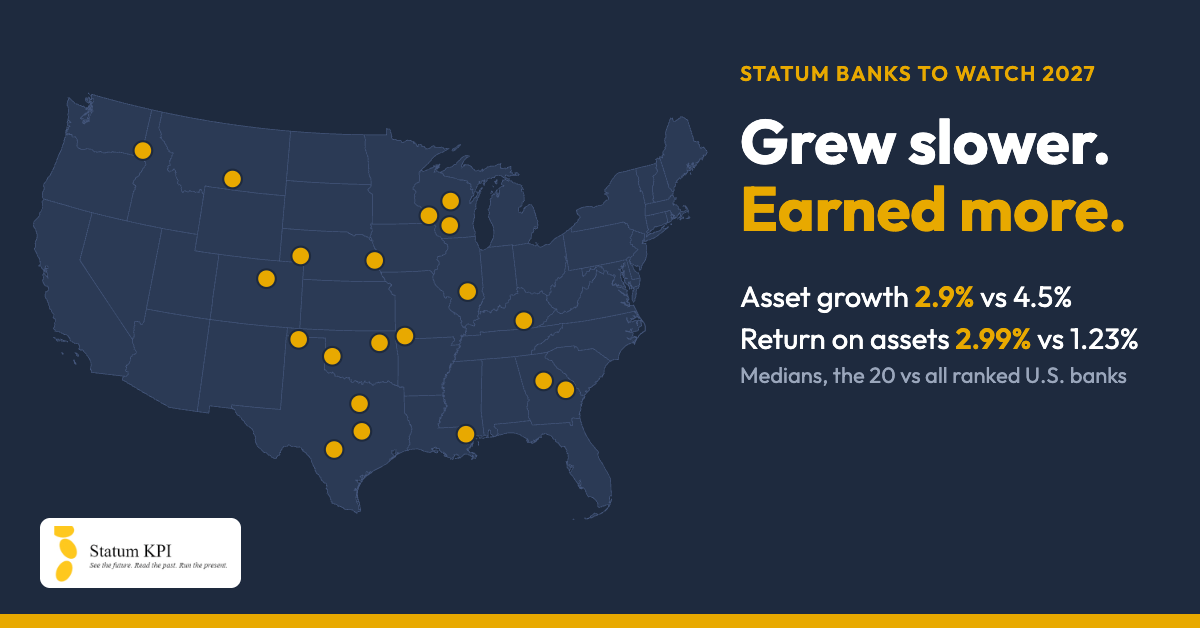
Statum's forecast picks the 20 U.S. banks best placed for 2027, and they grew more slowly than the typical bank over the past year. What sets them apart is how much they earn on each dollar and how little they spend to run the bank, and the same holds at every size. See where your bank ranks.
Bank rankings usually score the year that just ended. Amberoon's Statum forecasts what comes next: its GPA grades each ranked U.S. bank on where it will stand at the end of 2027, 18 months on from its June 2026 numbers. The 20 eligible banks with the highest GPA are the Statum Banks to Watch 2027.
The bank ranked first in the country grew its assets just 1.4% in the year to June. Cumberland Security Bank has four offices in Somerset, Kentucky, and $420 million in assets. In the first half of 2026 it earned an annualized 4.45% return on assets. By comparison, the median ranked U.S. bank earned 1.23%.
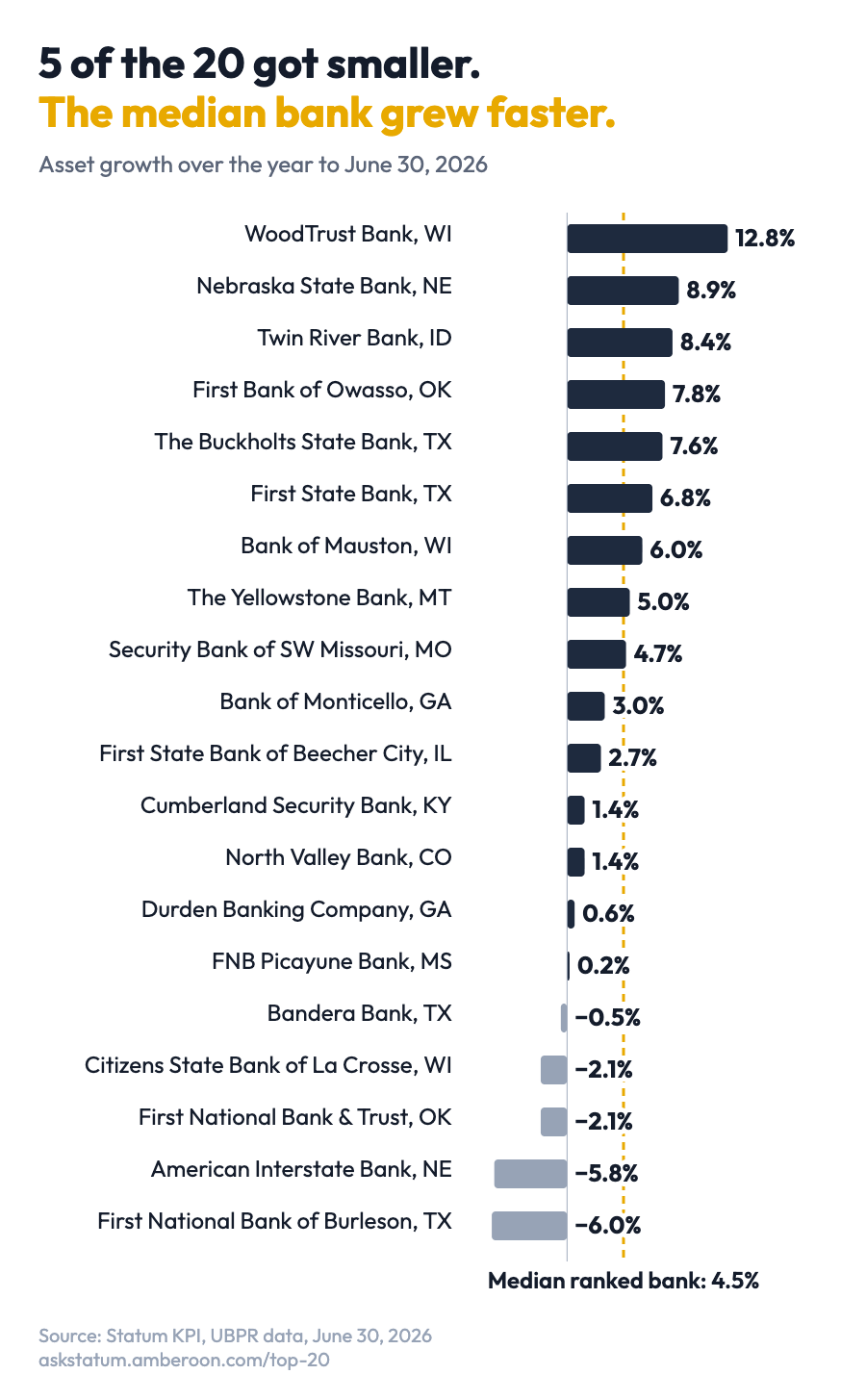
Cumberland is typical of the 20. The 20 Statum Banks to Watch 2027 grew their assets by a median of 2.9% over the year. All ranked banks grew 4.5%, and five of the 20 got smaller. What they share is a record of earning more on every dollar of assets and spending less to run operations. Their median return on assets is 2.99%, more than twice the median bank's. Nineteen of the 20 spend less than 50 cents to earn each dollar of revenue, while the median bank spends 62.
Is a 4% Return on Assets Just a Tax Quirk?
All 20 banks file as Subchapter S corporations. Their shareholders pay the federal income tax, not the bank. So the bank's reported return on assets sits close to a pre-tax figure, which flatters it next to banks that pay corporate tax.
Taxed at the 21% federal corporate rate, Cumberland Security Bank's 4.45% is still about 3.5%, nearly three times the median bank. The efficiency ratio, what a bank spends to earn each dollar of revenue, is calculated before tax. No tax election explains a bank running at 32 cents when the median runs at 62.
S&P Global Market Intelligence reached a similar verdict by a different road. Scoring eight metrics, it named American Interstate Bank of Elkhorn, Nebraska, the best-performing U.S. community bank under $3 billion for 2025. It is number 6 here.
Is This Just One Good Quarter?
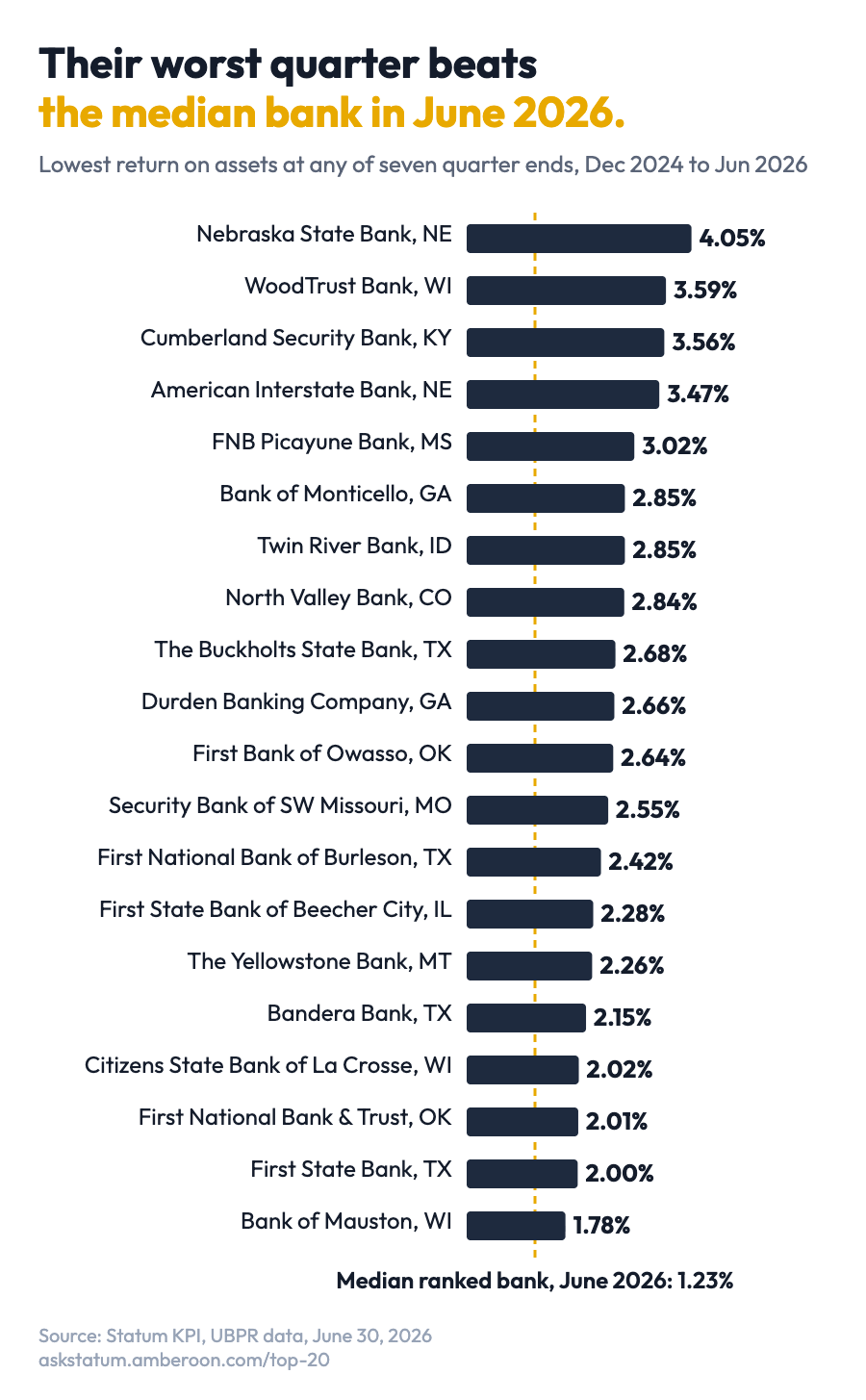
No. Statum tracks each bank over seven quarter ends, from December 2024 to June 2026. All 20 Statum Banks to Watch 2027 earned more on their assets than the median ranked bank at every one of them. The lowest return on assets any of the 20 posted was 1.78%, still above what the median bank earned in June 2026.
What Separates the Best Banks at Every Size?
The Statum Top 20 Showcase ranks a Top 20 in each of four size bands, so a $5 billion bank is measured against banks its own size. The pattern holds in every band. Among banks under $250 million, the Top 20 run a median efficiency ratio of 44.2%, against 65.1% for the rest of the band. Above $3 billion the gap is 45.5% against 59.1%.
The Showcase splits the extra return line by line on the income statement, and two lines do most of the work. Margin is the biggest. Among banks under $250 million, the Top 20's wider net interest margin adds 0.87 points of return on assets over the rest of the band, and lower operating cost adds 0.38, together 1.25 of the 1.53-point gap. Fees, provisions, taxes and other items make up the rest. Margin leads in three of the four bands, and only above $3 billion does lower cost edge ahead, 0.49 points to 0.45.
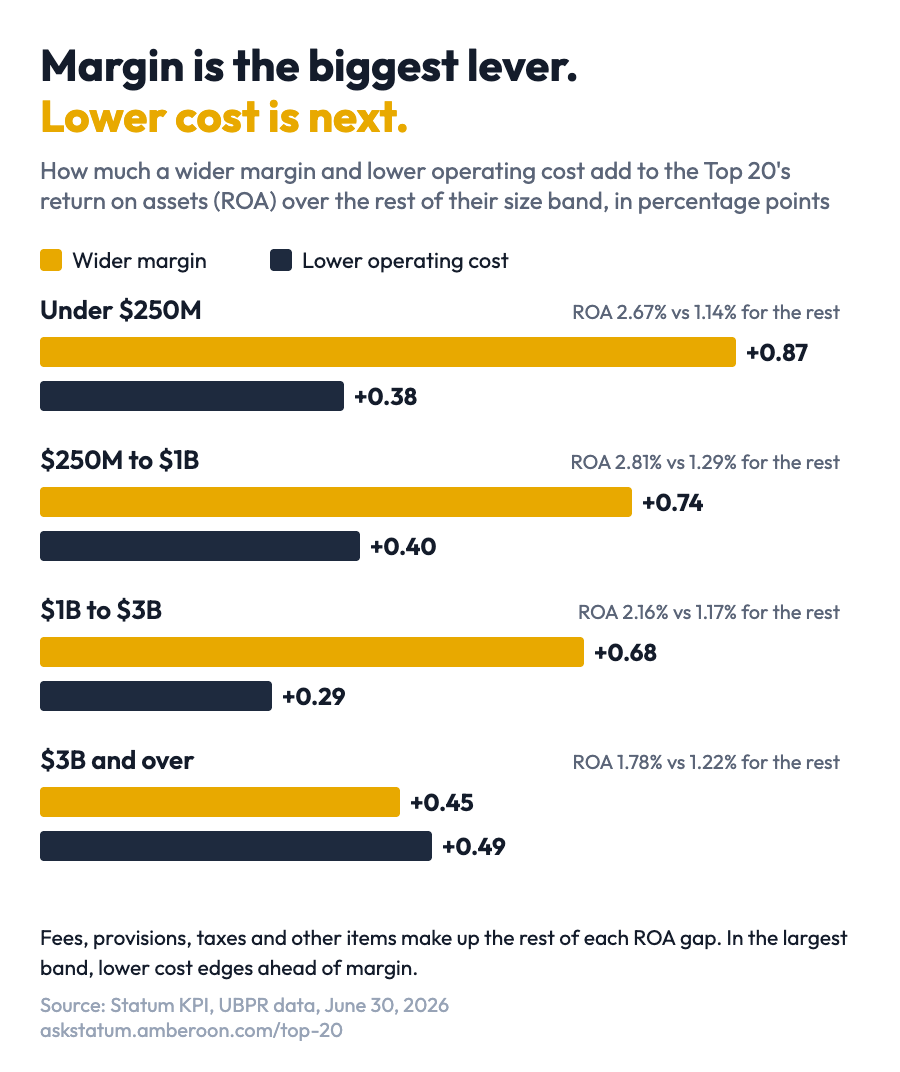
The margin comes from what these banks earn on their loans, not from cheap funding. In every size band the Top 20 earn a higher yield on loans than the rest. Under $250 million it is 7.45% against 6.72%, while they pay only a little less for their funds, 1.98% against 2.13%. The Showcase draws the same breakdown for your own bank, beside the Top 20 of its size.
Cost still counts. In the $250 million to $1 billion band, the Top 20 spend $2.16 a year on operating costs for every $100 of assets, and the rest of the band spends $2.56. On a $500 million bank, that 40-cent difference is $2 million a year.
Growth does not separate them. The Top 20 grew their assets faster than the rest of their band in three bands and slower in the fourth, by 0.25 to 1.45 percentage points either way.
How the Statum Banks to Watch 2027 Were Chosen
The Statum GPA is made from each bank's latest Call Report. It forecasts six measures of earnings and capital and grades each on nine letters, from C- to A+, scored 1 to 9. The GPA is the average of the six grades on that 1 to 9 scale. Every GPA now carries a band from the Statum Variability Index, which measures how predictable a bank has been. Cumberland Security Bank reads GPA 7.8 ± 0.4: A- to A, so even the low end of its band is an A-.
Of the 4,292 banks that file a Call Report, 3,503 are ranked. The rest are left out for a stated reason. Specialty, industrial loan, trust and credit-card charters are out, as are banks funded mostly by brokered deposits and institutions that barely lend. So is any bank that fails a ten-year conduct screen: a formal regulatory action, misconduct litigation, a settled class action, a material weakness, a customer data breach or negative news. Among the 3,451 ranked banks with $20 billion or less in assets, the 20 with the highest GPA are the Statum Banks to Watch 2027.
The 20 Statum Banks to Watch 2027
The 20 Statum Banks to Watch 2027 are, in order: Cumberland Security Bank (Somerset, Kentucky), The Buckholts State Bank (Buckholts, Texas), Bank of Monticello (Monticello, Georgia), Twin River Bank (Lewiston, Idaho), Security Bank of Southwest Missouri (Cassville, Missouri), American Interstate Bank (Elkhorn, Nebraska), First Bank of Owasso (Owasso, Oklahoma), WoodTrust Bank (Wisconsin Rapids, Wisconsin), FNB Picayune Bank (Picayune, Mississippi), Bank of Mauston (Mauston, Wisconsin), North Valley Bank (Thornton, Colorado), First State Bank of Beecher City (Beecher City, Illinois), Citizens State Bank of La Crosse (La Crosse, Wisconsin), Bandera Bank (Bandera, Texas), The Yellowstone Bank (Laurel, Montana), Nebraska State Bank (Oshkosh, Nebraska), The First National Bank & Trust (Elk City, Oklahoma), Durden Banking Company (Twin City, Georgia), First State Bank (Stratford, Texas) and First National Bank of Burleson (Burleson, Texas).
They come from 12 states, and 19 of the 20 hold less than $1 billion in assets. Twelve opened before 1935. Each size band also has its own leader. The Buckholts State Bank leads the banks under $250 million, and Cumberland Security Bank leads those from $250 million to $1 billion. The Yellowstone Bank leads from $1 billion to $3 billion, and InterBank of Oklahoma City leads above $3 billion.
The smallest of the 20, Nebraska State Bank in Oshkosh, Nebraska, has $74 million in assets and earns the highest return on assets among them, 4.65%. Farm loans make up 96% of its loan book.
The Yellowstone Bank in Laurel, Montana, is the only one of the 20 above $1 billion. It has 10 offices and $1.34 billion in assets. It runs the leanest operation on the list, an efficiency ratio of 31.2%, and leads all 515 ranked banks between $1 billion and $3 billion.
The oldest of the 20, WoodTrust Bank in Wisconsin Rapids, Wisconsin, opened in 1891 and grew the fastest, 12.8% over the year. It pays 1.17% for its funds against a median of 2.27%, cheaper than 95% of ranked banks.
American Interstate Bank in Elkhorn, Nebraska, reported no nonperforming loans at the quarter end. It runs an efficiency ratio of 31.4% and pays 0.77% for its funds.
How Does Your Bank Compare?
The Statum Top 20 Showcase answers that in one search. It places every ranked U.S. bank in its size band and shows its GPA, with the band that says how sure the forecast is. It sets your bank beside a Top 20 bank of the same size and breaks down where the gap in return on assets comes from, line by line on the income statement. Look your bank up, and read the gap in margin and operating cost as the size of the opportunity.
Statum KPI, from Amberoon, forecasts and benchmarks every U.S. bank across the full FDIC dataset. See where your bank ranks.
Popular Posts
Last week the Federal Reserve did the one thing...

In February 2026, Anthropic ran a Claude Code...