

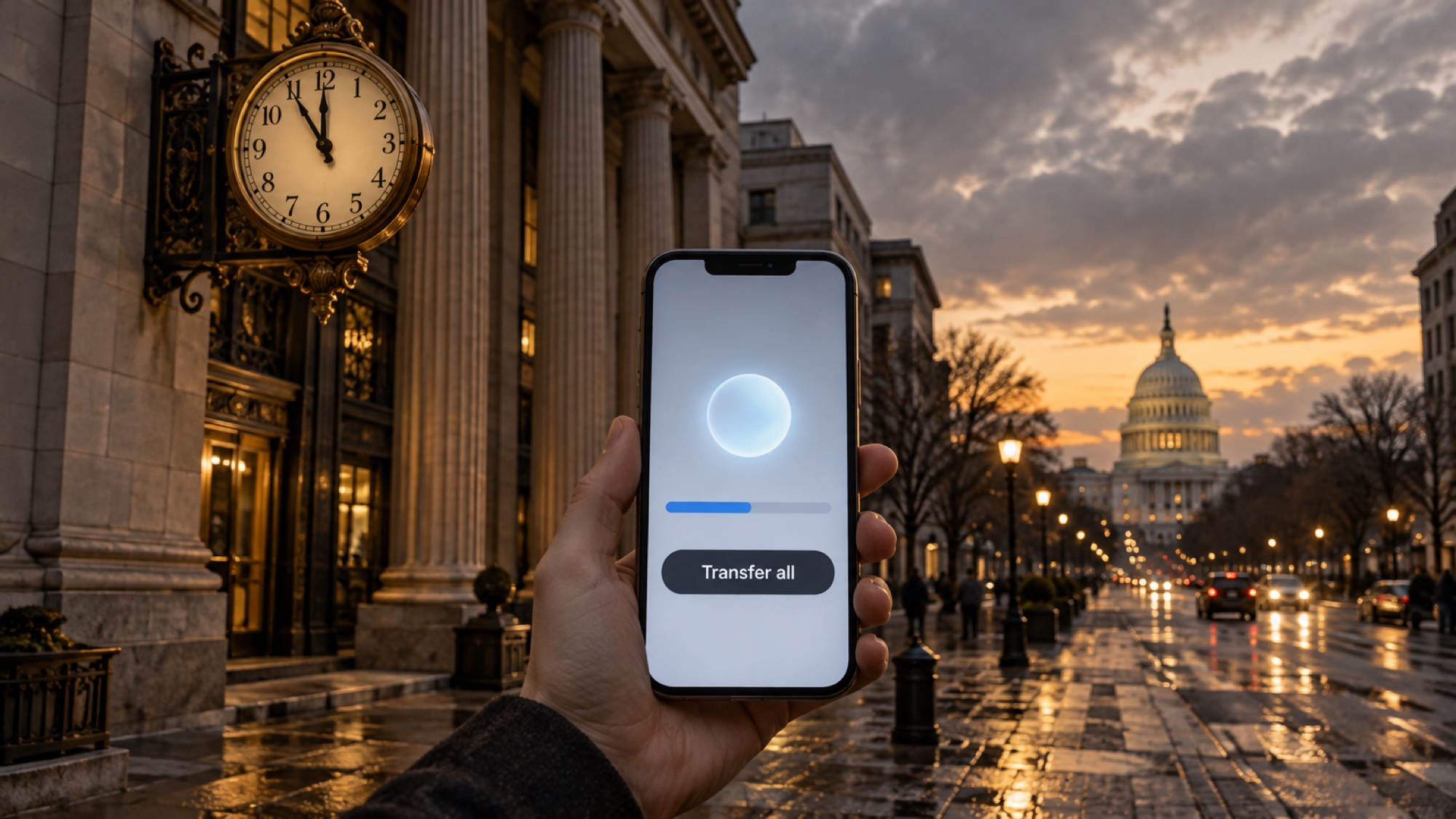
On March 9, 2023, venture investors picked up their phones and told their startups to get out of Silicon Valley Bank. By the close, $42 billion was gone. A quarter of the bank's deposits, in a single day. By the next morning, the bank was gone too.
It didn't take a crowd. It took a small circle of people who watched the bank closely and could move fast.
This fall, that changed. AI agents began handing those two things to anyone who uses one. An agent doesn't sleep. It doesn't wait for the morning paper. It reads every filing and every headline, and it tells its owner to get out the moment it sees trouble. A run used to take a small circle. A single new agent app reached 5 million downloads in 22 days, and each one puts that adviser in someone's pocket.
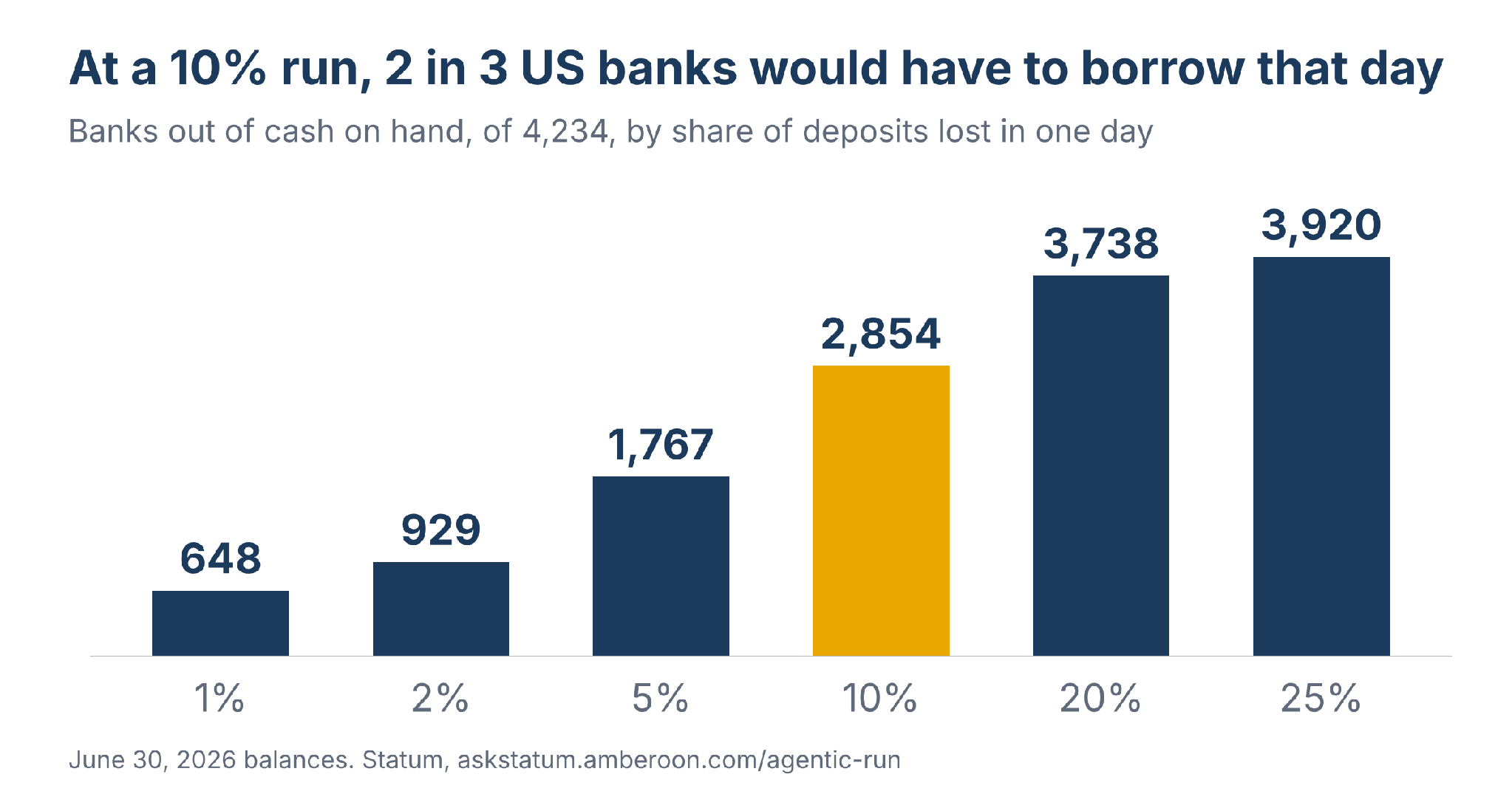
That would be survivable if banks had cash to spare. They don't. We ran the scenario numbers for all 4,234 US banks. If any one of them lost 10% of its deposits in a day, two in three would run short of cash and have to borrow before the close.
Nobody keeps a Doomsday Clock for banks. Someone should. If they did, its hand would have jumped a minute toward midnight this fall. Here is what moved it, and how much time a bank has left to plan.
What Moved the Doomsday Clock This Fall
That app is Meta's Muse, launched September 8. By Sensor Tower's estimate, ChatGPT took 56 days to reach the same mark. On September 27, Apollo's chief economist, Torsten Slok, put numbers on what an agent like it could do: checking accounts pay about 0.1%, online accounts pay 3.3% to 5%, and an agent managing a household's cash could close that gap for millions of people at once.
Muse itself cannot move money between banks today. It reads balances and transactions, it does not execute transfers, and its early momentum has cooled. But the rails for the step from reading an account to acting on it are already laid. In 2025 Stripe and OpenAI released an open protocol that lets an agent start a payment with a token limited to one merchant and one amount. In April, Stripe added wallets built for agents, where the customer approves each purchase. With the model behind Muse now open, the next agent that moves money need not come from Meta, and it need not log in to the bank it drains.
Earlier waves took years. ATMs, introduced in 1969, took a decade to catch on, and in the Federal Reserve's surveys mobile banking took four years to double its users, from 22% to 43% of phone owners. Agents spread faster because they are cheap: Stanford's 2025 AI Index found the cost of running a system as capable as the original ChatGPT fell more than 280-fold in under two years. The step from reading a balance to moving it may take quarters, not years.
Why Congressman Foster Is Warning Banks
Congress saw this coming in June. Representative Bill Foster of Illinois is the only PhD physicist in Congress. He earned his doctorate at Harvard and spent 22 years at Fermilab, where he was part of the team that discovered the top quark. At a House Financial Services hearing on June 4, he told the heads of the Federal Reserve, the FDIC, the OCC and the NCUA that the banking system is not prepared for an agentic AI bank run. Silicon Valley Bank lost $42 billion in a single business day; with agentic AI, he said, the same run could have happened in seconds rather than hours. In an interview with Banking Dive five days later, he asked readers to picture customers whose personal agents carry standing orders to withdraw at the first report of trouble.
He is not predicting a collapse. He is making an engineering argument: when the speed of a potential failure changes, the speed of the response has to change with it. His proposals point the same way, toward live data that supervisors and the lender of last resort can act on, including the assets each bank can pledge to the discount window and its capital position.
Why Planning for an Agentic Run Is a Safety and Soundness Obligation
Preparing for an unlikely but severe event is not alarmism. It is the job. Banks plan for cyberattacks, pandemics and the loss of a core processor without believing any of them is likely next quarter, because safety and soundness means being ready for the contingency, not betting against it.
Regulators have already said what readiness looks like for funding. In July 2023, after the spring's bank failures, the OCC, the Federal Reserve, the FDIC and the NCUA issued an addendum to their interagency policy statement on liquidity risk. It tells every institution, community banks included, to keep a broad range of contingent funding sources, to test its contingency borrowing lines, to be operationally ready to use the discount window if the plan counts on it, and to revise the contingency funding plan as conditions change.
The questions regulators began asking this month go further: what limits a bank places on AI agents, whether humans still make the key decisions, and how the systems would be shut down. The Financial Stability Board has recommended controls of its own, including human or dual approval above set thresholds, restricted direct access to payment systems and an audit trail for every agent. None of it yet addresses the speed of a deposit run, and that is the gap a contingency funding plan has to close. A plan written for depositors who need a branch, a phone call or an afternoon assumes a speed of outflow that may not hold much longer.
How Many Banks Would Have to Borrow in a Targeted Run?
The useful test is not an even outflow spread across every bank, which almost every bank can absorb. It is a run concentrated on one bank, the scenario Foster describes. Cash on hand here means the cash and overnight funds a bank could pay out without falling below 2% of its assets. Measured against June 30, 2026 balances, the number of banks that run out of it climbs quickly as the run grows.
At a 1% one-day run, 648 of 4,234 banks would have to borrow or sell securities the same day. At 5%, 1,767 would. At 10%, 2,854 would, the two in three in the headline. At 25%, roughly Silicon Valley Bank's first day, 3,920 would, and about 2,900 would still fall short after selling every security not already pledged as collateral.
Where does your bank sit? Ask Statum shows how many hours your cash on hand lasts at a 5%, 10% and 25% run.
Borrowing the same day is not failure. The July 2023 guidance sets the test: the borrowing line is sized for the outflow, the collateral is already lodged, and the bank has used the discount window before it needs it. Uninsured balances sharpen the risk, because large accounts are the ones an agent acting for a business would move first. The median bank holds about 25% of its deposits above the insurance limit, and 246 banks hold more than half of their deposits above the limit. Larger banks report uninsured deposits directly; for the 3,236 smaller banks that do not, the figure is estimated from the balances they file for accounts over $250,000.
These are June 30 balances. Cash positions move every day, which is the point of running the drill on today's numbers rather than last quarter's.
How Far Would One Failure Spread? The Blast Radius
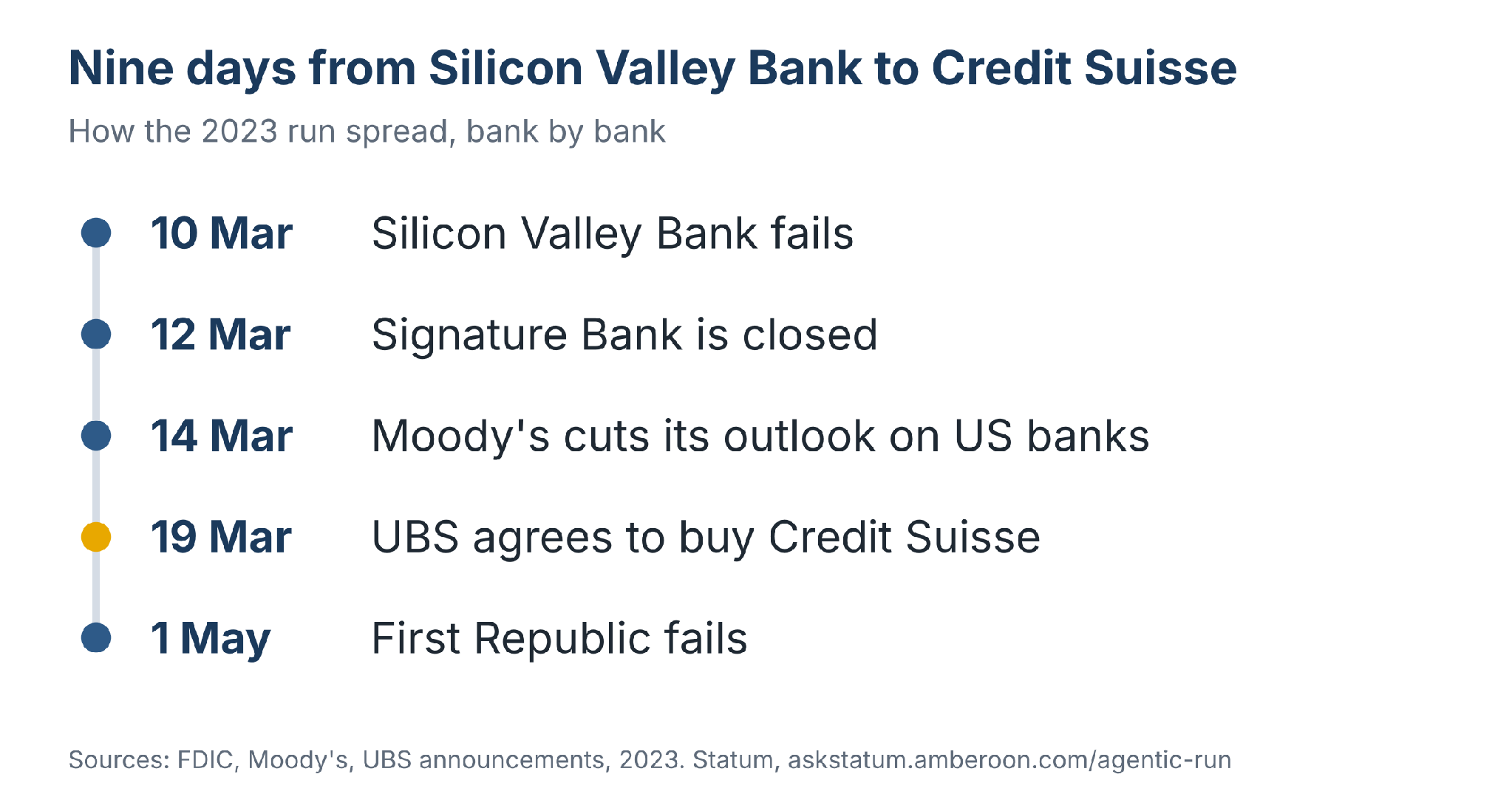
In 2023 the run did not stop at Silicon Valley Bank. Signature Bank was closed two days later. Regional bank shares slumped: Western Alliance, which survived, lost more than half its share price in three trading days, and Moody's cut its outlook on the entire US banking system. First Republic held on until May 1. Within nine days the turmoil had reached as far as Credit Suisse. The contagion traveled along the same weaknesses Silicon Valley Bank had: banks that looked like it were run, and the rest of the sector was repriced.
Think of the contagion as a blast radius. Ground zero is one bank that fails the way Silicon Valley Bank did. The rings around it are the banks that share, on tests we set, the weaknesses that reviews of its failure pointed to: more than half of deposits uninsured, unrealized securities losses above a quarter of Tier 1 capital, and thin cash on hand (below 5% of deposits). Cash stands in for readiness here because the filings do not show how ready a bank is to borrow. On June 30, 2026 balances, 7 banks share all three, 319 share two and 1,816 share one.
If the 7 banks sharing all three weaknesses lost 25% of their deposits in a day, the 319 sharing two lost 10% and the 1,816 sharing one lost 2%, about $387 billion would leave within the day. In all, 1,074 of those 2,142 banks would run short of cash on hand by about $91 billion, to be borrowed or raised by selling securities before the end of the business day, and 95 could not cover the outflow even by selling every unpledged security.
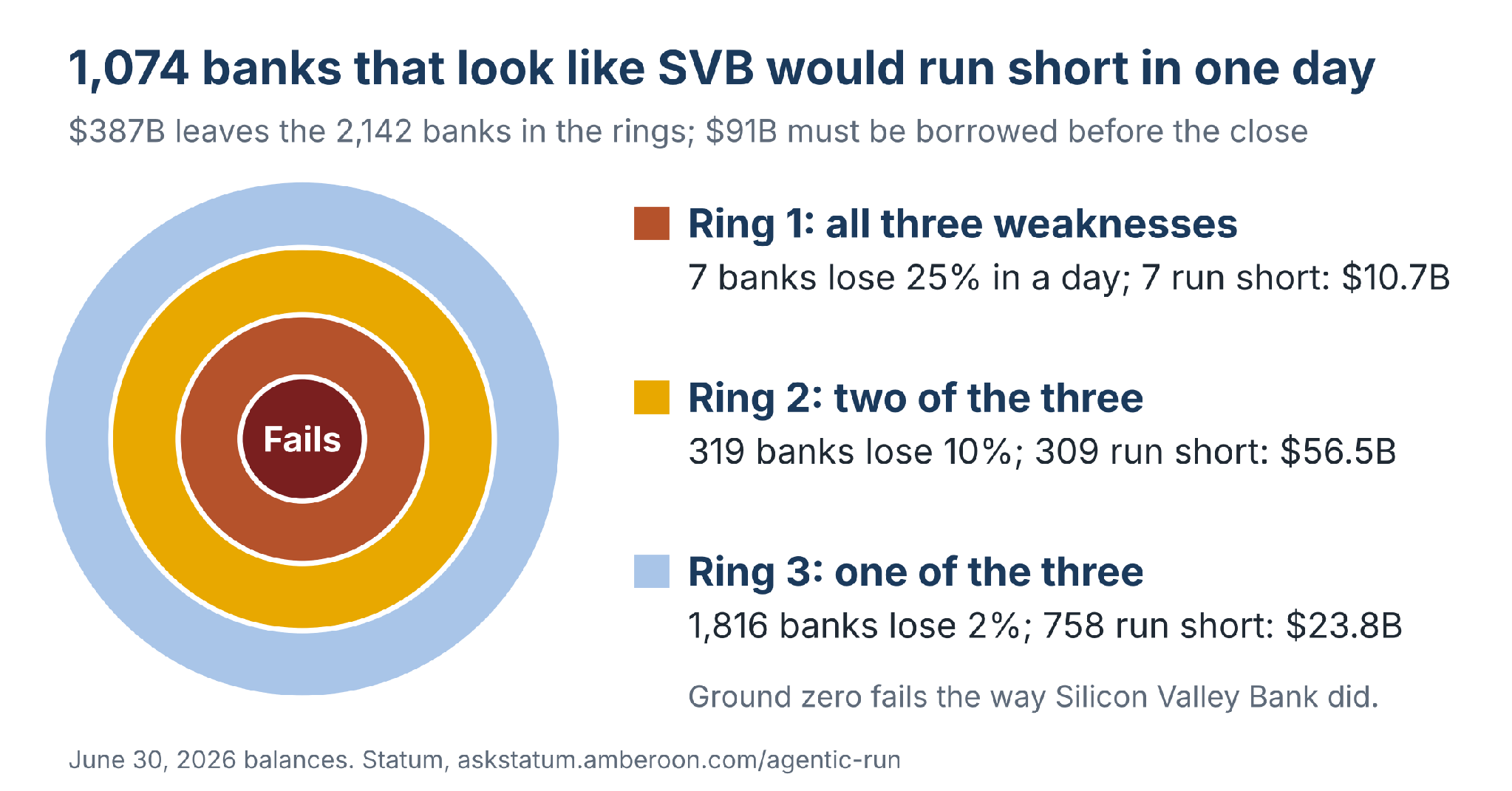
In 2023 contagion took days to spread. Agents acting for many depositors on the same signal could put the first rings into the same day. That is the reading on the clock: not a run, but a run that could arrive faster than a plan written for afternoons. The rings are drawn from counts, not names: publishing which banks sit closest to ground zero would hand every depositor's agent the same signal.
Isn't Repricing the Likelier Cost of AI Agents?
Yes, and the strongest objection to planning for a run is that agents are more likely to raise a bank's deposit costs than to empty it. JPMorgan CEO Jamie Dimon's warning, on October 13, that customers carry the risk when they hand an agent their keys, and the trust customers place in their bank, are real brakes on how fast agents spread. In October, the Financial Times's Lex column estimated that AI agents could put about $500 billion of US bank equity value at risk by eroding cheap, sticky deposits. US banks hold $4.19 trillion of noninterest-bearing deposits; paying 1% on them would cost about $41.9 billion a year, about 9% of the industry's annualized pre-tax income, and about 12% of pre-tax income for the median bank.
That cost deserves a pricing plan of its own. But likelihood is not the standard for contingency planning; severity is. A bank does not skip its fire drill because the building is unlikely to burn. Repricing is the cost to budget for; the run is the event to be ready for. A prudent bank prepares for both, and the run is the one that cannot be improvised on the day.
What a Bank Should Do Before the Doomsday Clock Moves Again
Five steps, in the order a board would take them. None of them stops the clock. Each one buys back time on it. The first three answer the weaknesses that sank Silicon Valley Bank. On September 18, Federal Reserve Vice Chair for Supervision Michelle Bowman released the first findings of an independent review by the Starling Advisory Group. It found three weaknesses working together: unrealized securities losses that exceeded the bank's capital, a deposit base that was 94% uninsured, and no operational readiness to borrow from the discount window.
1. Measure your one-day cover. Work out how much of a one-day outflow cash on hand covers at 5%, 10% and 25% of deposits, compare that with your peers, and find which ring of the blast radius your bank sits in.
2. Make the borrowing real. Confirm the Federal Home Loan Bank and discount window arrangements, lodge the collateral now, and run a small test transaction, as the 2023 guidance expects.
3. Know which balances could move together. Identify the largest uninsured accounts, the operating accounts tied to a few commercial relationships, and any deposits gathered through a single channel.
4. Update the contingency funding plan for agents. Write the agent scenario into it explicitly, with an outflow speed measured in hours, and take it to ALCO and the board.
5. Price the deposits you mean to keep. Decide which deposits you would pay up to keep and at what rate, so repricing is a choice rather than a scramble.
How Many Hours Would Your Cash Last?
Ask Statum. The Agentic Run Stress Test answers that question for any of the 4,234 US banks. It shows how much leaves, how many hours cash on hand lasts and how much must be borrowed before the close. It also shows what the run costs over a year, how your bank compares with its peers and which ring of the blast radius it sits in. And it prices deposit repricing, the likelier case, so the board sees both on one page.
The Doomsday Clock is a reading, not a prophecy. Midnight is not inevitable. But the hand moved this month, and the time to rehearse is before it moves again.
Amberoon builds Statum, bank analytics that turns every bank's filings into the numbers a board acts on, from stress-testing the contingency funding plan to defending net interest margin.
Popular Posts
Last week the Federal Reserve did the one thing...

In February 2026, Anthropic ran a Claude Code...