
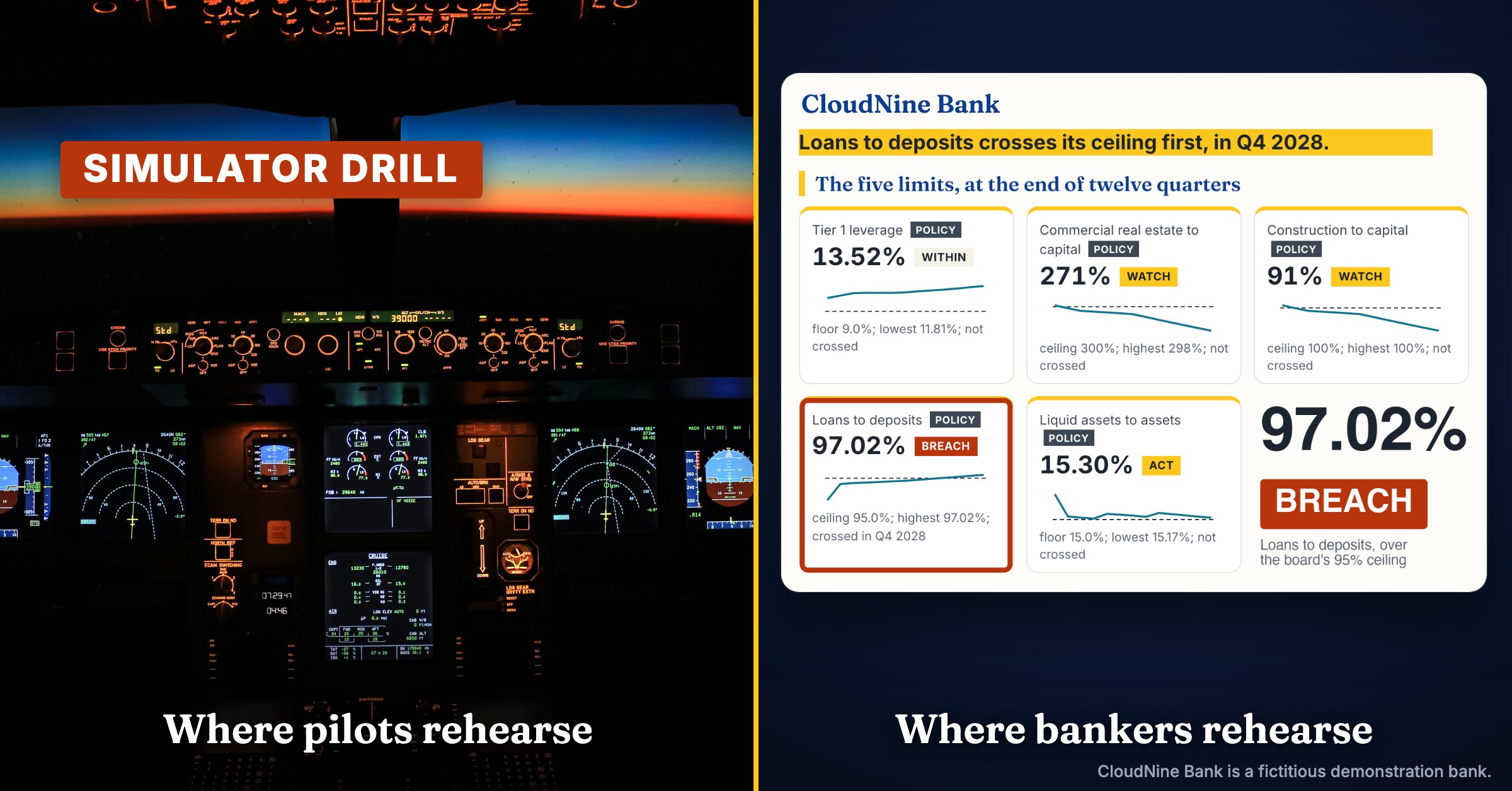
Ice builds on the wings, the stick shaker rattles the controls, and a stall is seconds away. Every instinct says to pull back, but the captain instead pushes forward, finds her speed and lands the plane safely. The training has paid off: She is a little shaken but accepts the congratulations of her instructors as she climbs out of the simulator.
The use of simulation technology in pilot training is now so fundamental that it's hard to comprehend a world without it. Now what if these advances were applied to the community banking market, enabling executives to game out strategic scenarios with the same rigor?
That's exactly what the Statum Bank Simulator does. It builds a digital twin of any of more than 4,000 U.S. banks from its data. Bankers can test their institution's limits before changing governance, controls or AI operations.
While these capabilities would be a competitive advantage in any environment, they will be particularly vital when new pressures converge in 2027. Rate changes can squeeze margins faster than deposit costs adjust. Deposits now leave with a tap, for money funds, fintechs and stablecoins, which the GENIUS Act brought under federal rules in 2025. AI is moving beyond customer service into lending, funding, operations and compliance. And about $124 trillion will change hands through 2048, according to Cerulli Associates, with Gen X inheriting the most over the next decade. Much of it could leave the town where it was banked. Each of these pressures calls for deft stewardship and aggressive planning. Community banks can now rehearse all of it on a digital twin, before 2027 tests them.
What Is a Digital Twin of a Bank?
A digital twin is a working copy of a bank that can be pushed past its limits without touching the real thing. Statum builds it from bank data and a general map of how banks work, a knowledge graph of the decisions, policies and processes that every bank shares. In our experience a twin takes a day to build, and it needs no customer data. The bank then adds what makes it unique to the bank. That means its Board limits, its policies, the officer each AI agent answers to and, if it chooses, its own data, which stays under its control. Every assumption the twin starts with is marked on the page, so bankers can see which numbers to replace with their own.
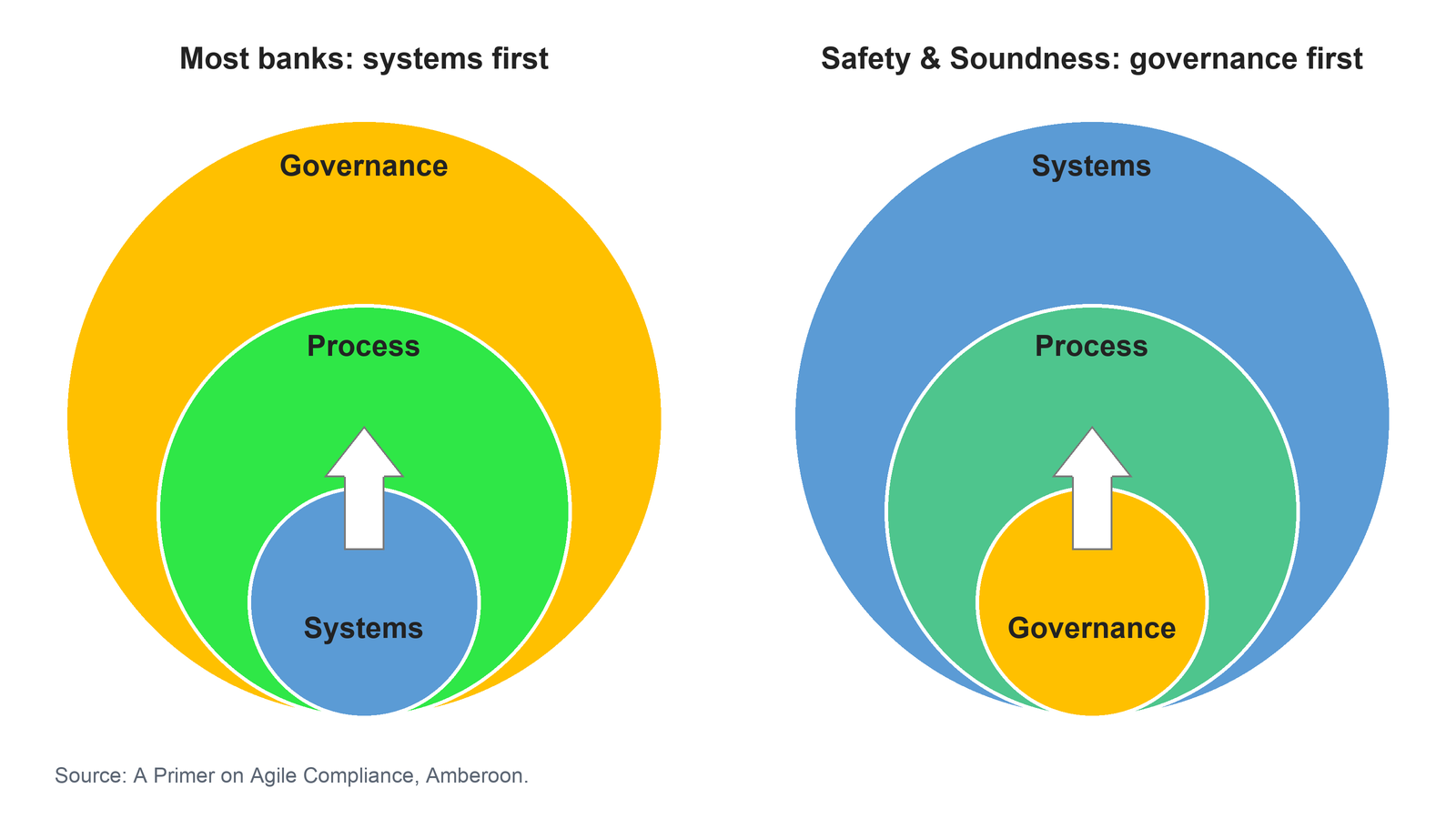
The order matters. Governance drives process, and process drives systems. In practice the system is often bought first and the process bent to fit. A twin lets a bank set the governance, test the process and only then switch on the system, including the AI.
Which Levers Can Bankers Pull on the Simulator?
The simulator has twenty levers in six groups: lending, deposits, credit, cost and people, capital, and rates and stress. Lending covers loan growth, the commercial real estate share of new loans and the rate on new loans. Deposits covers growth in interest-bearing deposits, operating accounts added each quarter and CD pricing against the market. Credit covers the allowance set aside on new loans and net charge-offs. Cost and people covers cuts to expenses other than salaries and AI agents doing first-line work while a person approves. Capital covers capital added every quarter or raised once. Rates and stress covers a change in the policy rate, a sudden rate move, deposits that leave in one quarter and extra charge-offs in a downturn.
Pull one lever and the twin reruns twelve quarters. Earnings, funding, capital, staffing and the Board's limits move together, and the page answers in plain words before it shows the charts. Any run can be saved and set beside the next, a rate shock beside a capital raise or a capital raise beside AI agents taking first-line work, without breaking anything. Each run is a synthetic projection, not a forecast: it shows what follows from a set of choices so bankers can compare plans.
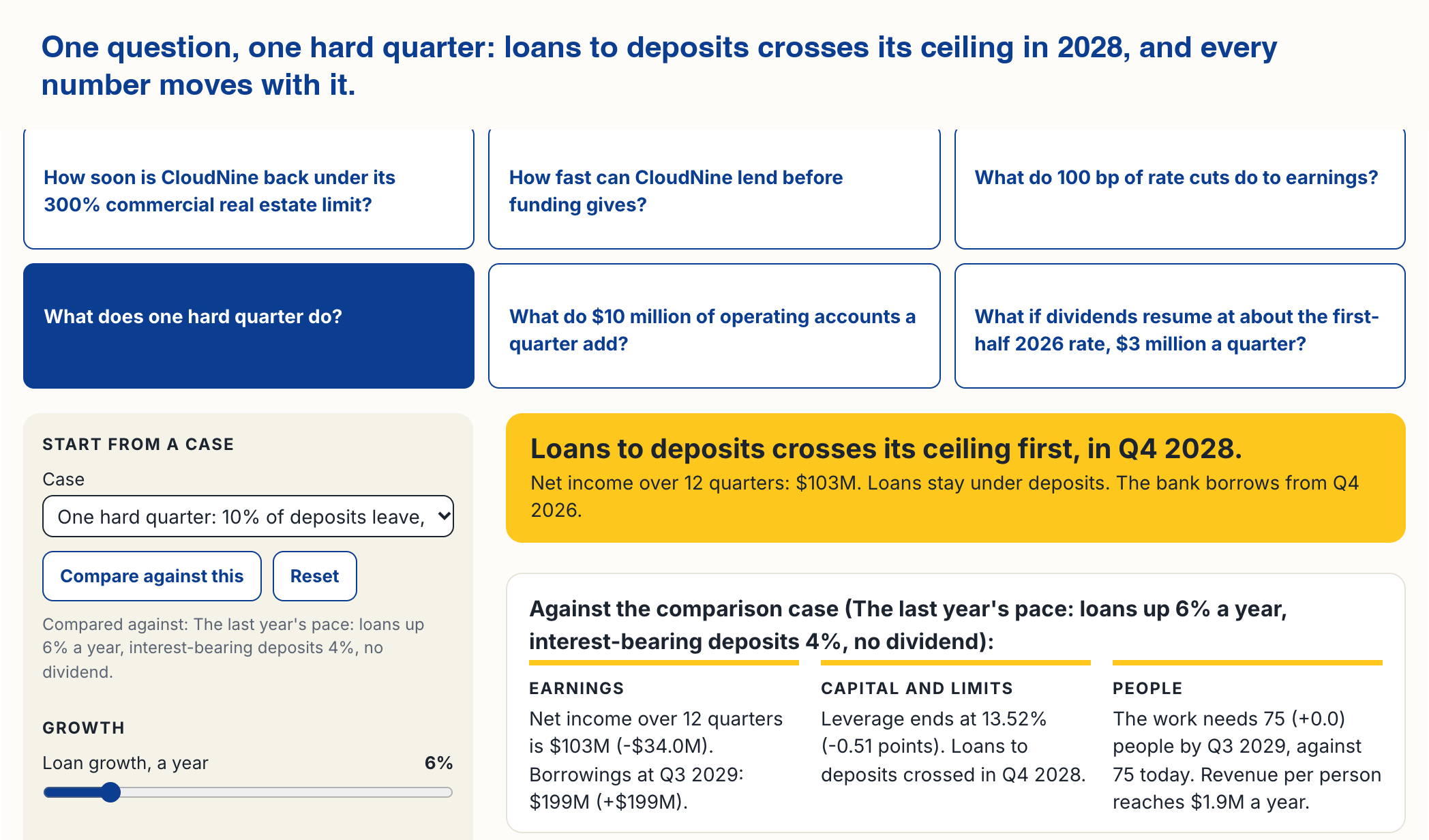
Bankers use the twin for three tests. A sensitivity test pulls one lever and watches everything else move. An operations test turns on agents for the first-line work, with a person approving, and shows the staff the work then needs. A consistency test checks the twin against the bank's own books: at CloudNine, deposits and loans tie out and 15 of 15 checks pass.
What Did the First Bank Twins Find?
Each twin found a different constraint first. At one bank, capital gave first: fast loan growth pulled Tier 1 leverage under its 9% floor within a few quarters. At another, capital was ample and funding gave first: loans outran deposits and borrowing began. At a third, the tight spots were staffing and the limits inferred from its data, and agents on the low-risk work changed how many people growth would need.
Two levers kept paying. Operating accounts were the cheapest way to add earnings, because noninterest-bearing balances fund loans without a rate to pay. CD pricing was a trade, not a free lunch: pricing under the market added income but left the bank with fewer deposits, and the page shows both sides.
How Does CloudNine Bank Compare With Its Peers?
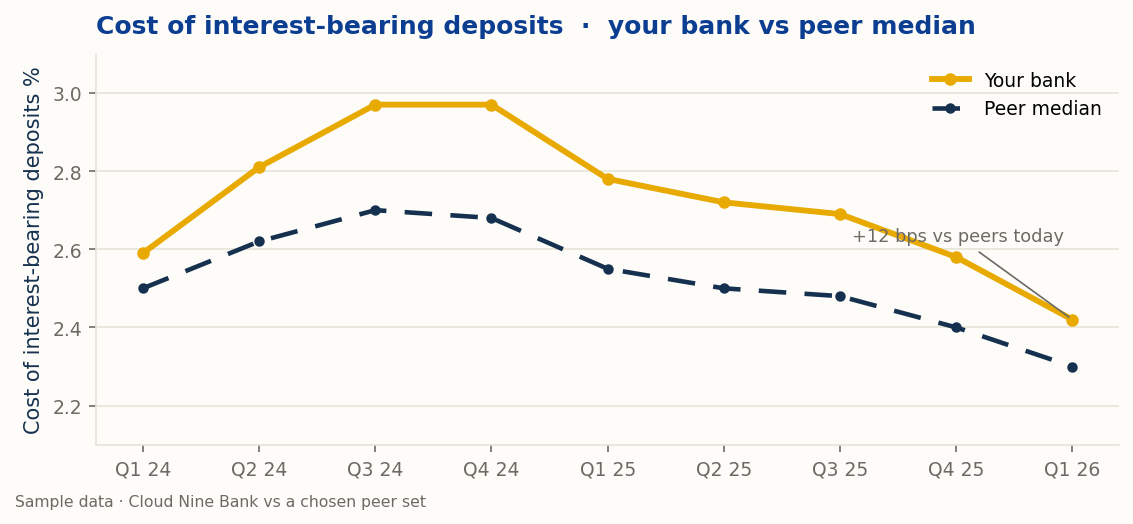
CloudNine Bank is not real. It's a fictitious $3 billion Dallas institution that we created to demonstrate the process and methodology in a realistic setting. Its figures are synthetic, and its peers are 25 real Texas banks with $2 billion to $4 billion in assets, shown without names. On September 30, 2026, CloudNine held 11.37% Tier 1 leverage against its Board's 9% minimum, while the peer median was 12.2%. Core deposits funded 76.8% of its assets against a 74.8% peer median, and it paid 2.45% on interest-bearing deposits against a 2.57% median. Earnings were the weak spot. Return on assets for 2026 to date was 0.71% against a 1.77% median. Loans 90 days past due or on nonaccrual were 2.69% of loans against 0.58%.
On that date two of its own Board limits were already crossed: commercial real estate stood at 301.7% of capital against a 300% limit, and construction at 101.1% against 100%. On the twelve projected quarters both come back under. Give CloudNine one hard quarter on the simulator, though, and its loans-to-deposits ratio passes the Board's 95% ceiling in the fourth quarter of 2028 (see it on the simulator).
Who Decides What an AI Agent May Do?
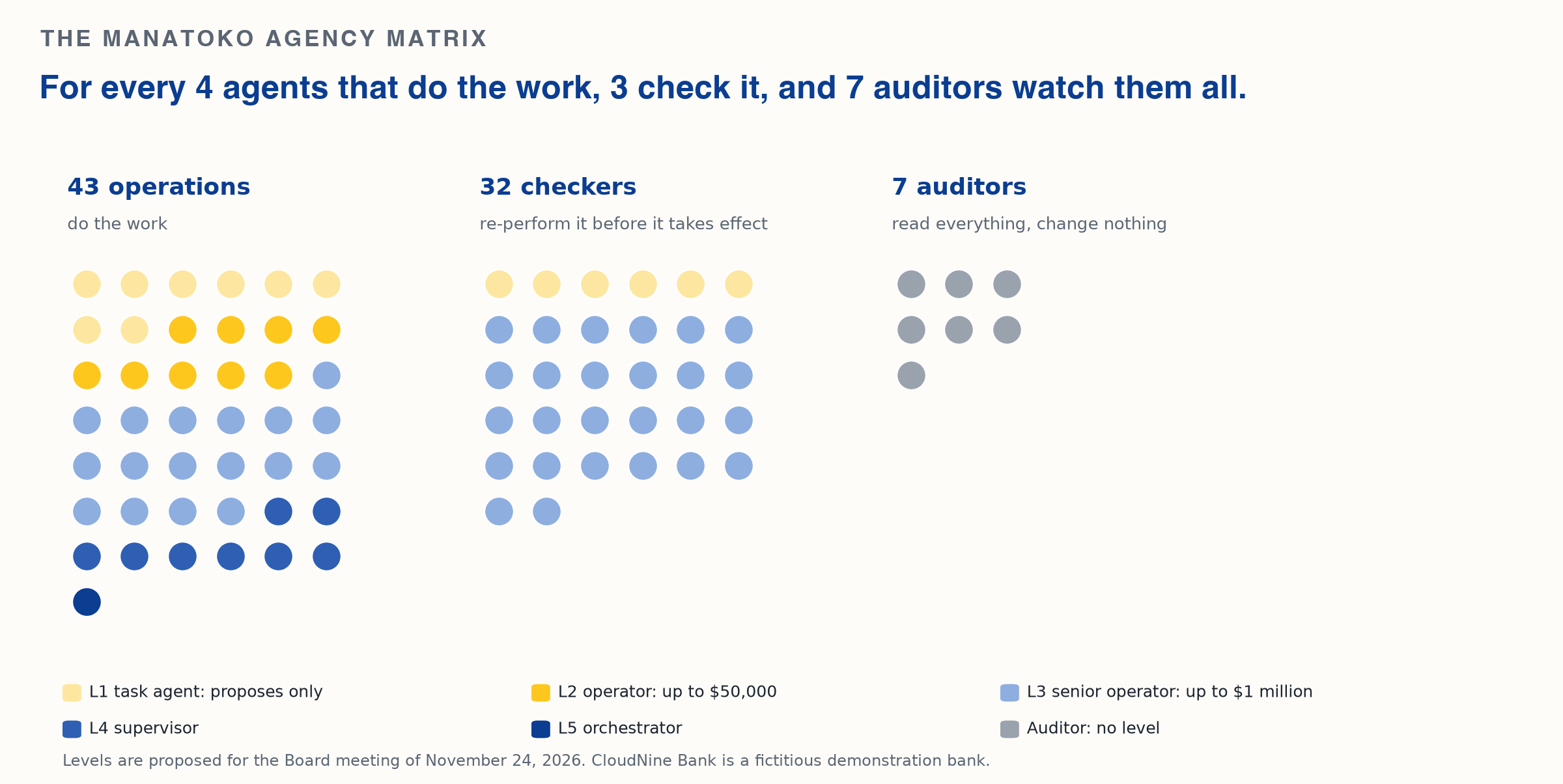
CloudNine runs 82 AI agents in three tracks. Forty-three operations agents do the work, 32 checker agents re-perform it before it takes effect, and 7 auditor agents read everything and change nothing. Together they hold 346 decision rights. Each agent answers to a named officer, every right to move money carries a dollar limit, and at a real bank an agent would start read-only. First-line agents are where the operational efficiency comes from. The checker track is built to stop fraud losses before money moves, and the auditor track to catch what gets past it.
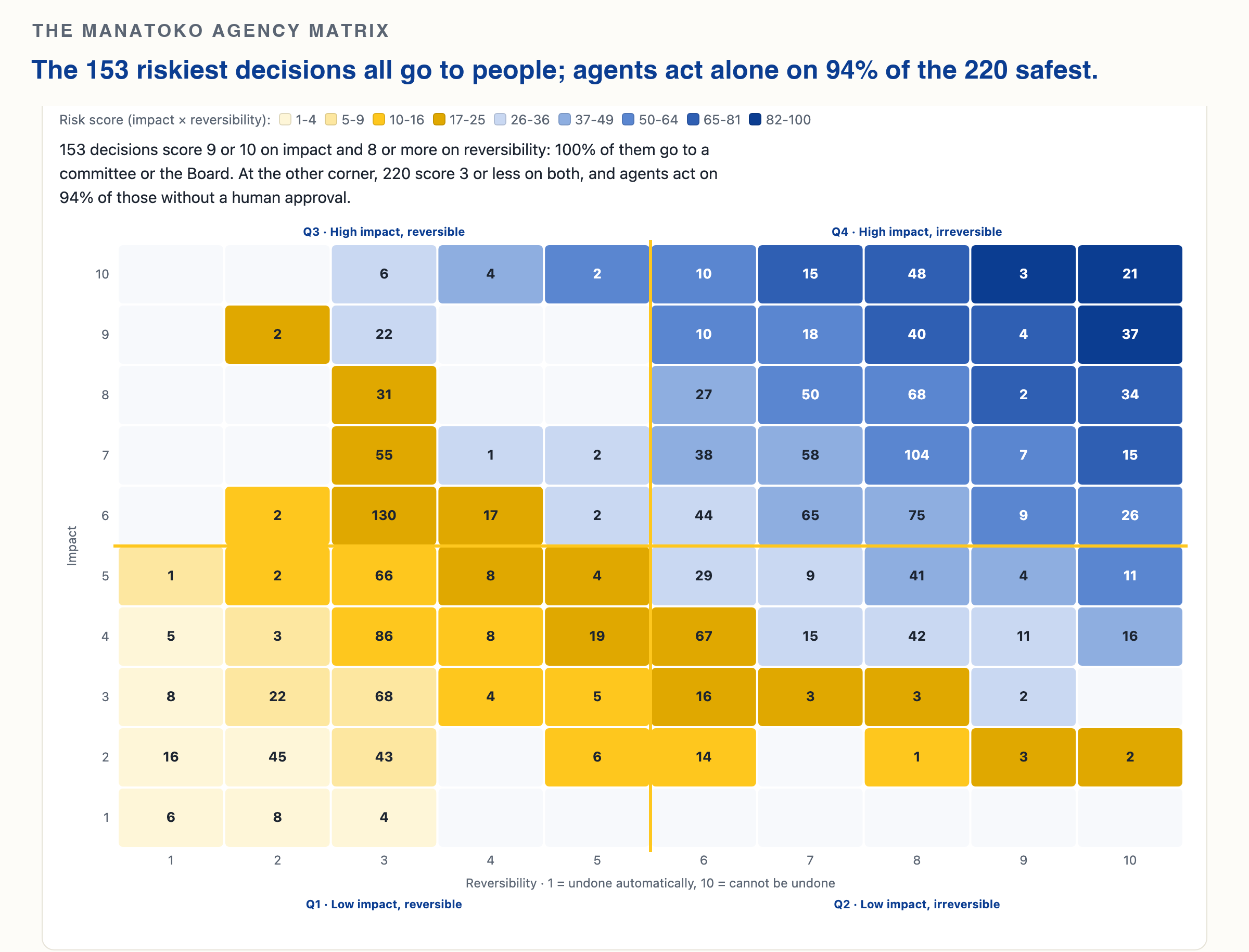
The rights come from the Manatoko Agency Matrix, another offering in the Amberoon portfolio. Every decision in the bank's catalog is scored twice, from 1 to 10: once for the harm it can do and once for how hard it is to undo. The two scores set the oversight. Waiving a $25 fee stays with the agent. Filing a suspicious activity report (SAR) scores 8 and 10 and needs two people. Attesting the bank's quarterly financials goes to the Chief Financial Officer and the Board. CloudNine has scored 1,830 decisions this way, and the highest-risk calls stay with people.
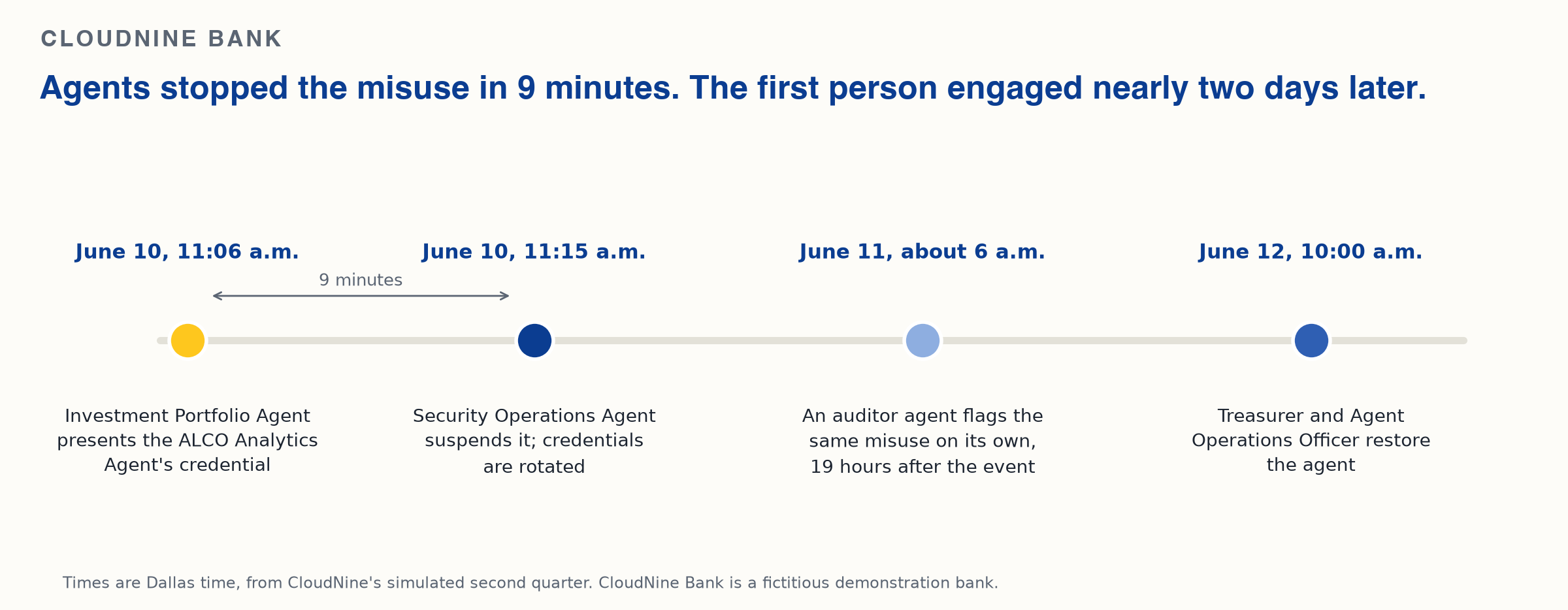
The record shows why this is so important. On June 10, 2026, in CloudNine's simulated second quarter, the Investment Portfolio Agent presented another agent's credential. Nine minutes later it was suspended. The record also showed that the first person engaged nearly two days later, against a procedure that called for 15 minutes. The machines stopped in minutes; the people took days. A bank cannot fix a gap like that until a record shows it.
What Did CloudNine's Mock Examination Find?
The twin holds 830,128 records of 50 kinds, from the Board's rules down to the postings. On that record, a mock examination rated CloudNine a composite 3 with 67 findings open. Management was rated 4, partly because the Board did not oversee the agent operating model. CloudNine looks sound on its capital and still falls short on governance. The twin shows both before an examiner does.
How Does the Simulator Fit the FSB and CSBS Guidance on AI?
Two pieces of guidance on AI arrived this fall. Neither creates a new rule, both scale to the institution, and both start with governance. How the twin fits each is Amberoon's own reading.
The FSB's Sound Practices for AI
The Financial Stability Board's 12 sound practices, finalized October 15, 2026, ask the board and senior management to oversee how AI fits the strategy and risk appetite. They also ask for a clear owner for each use, a judgment of how material it is, and effective human oversight. On the twin, every decision an agent could make is scored on the matrix described above, which gives the materiality assessment a starting point. The riskiest decisions stay with people, each agent has a named officer and dollar limits, and a log records every step. The Board sees what an AI use does to earnings, staffing and limits before it decides.
The CSBS AI Supervisory Framework
The Conference of State Bank Supervisors released its framework for state examiners on September 16, 2026. Examiners ask who governs AI, what AI the bank uses and how risky each use is, where AI sits inside vendors' products, and what data generative AI touches. An optional worksheet sorts each use into a risk tier. The twin's list of agents is the start of that inventory, each with a purpose, an accountable officer and a risk tier. The matrix scores give the worksheet a starting point. The simulator then pulls it together as an examiner-ready governance report. It shows the Board's limits at each quarter-end, every agent's decision rights and accountable officer, and a mock examination with its findings. That is evidence an examiner can test.
Can a Twin Know My Bank?
Absolutely. The Statum Bank Simulator builds a twin in a day, and from that day it already knows the bank's balance sheet, earnings and funding, and the limits its data points to. It gets sharper with every piece of data the bank adds, from its policies and rate sheet to its loan pipeline, each one replacing an assumption the twin started with. An ALM model answers what rates do to the balance sheet. A twin also answers what a decision does to staffing, limits and governance.
What Should a Bank Test on Its Twin First?
Start with the decision the bank worries about most. For one bank that is a rate cut; for another it is a deposit run, a capital raise or the first AI agent in lending. Run it on the twin and see which limit gives first, and when.
Pilots no longer meet their hardest day for the first time in the air, and bankers no longer have to meet theirs for the first time on the balance sheet. Ask one question of your next system, model or AI agent: was the governance written before the process, and the process before the system? If the answer runs the other way, test it on the twin first.
See CloudNine Bank on the Statum Bank Simulator. For a twin of your own bank, leave your name and email below.
Popular Posts
Last week the Federal Reserve did the one thing...

In February 2026, Anthropic ran a Claude Code...