

The number 150 has a nice symmetry to it: precise, well-rounded and seemingly high but not unreachable. It's also the legendary Dunbar's number — the cognitive limit of how many meaningful relationships a human being can sustain. It's also the number of soldiers in a company within a military, and for a while at least, it was apparently the average number of 'friends' in the Facebook universe.
But here's the best milestone: Out of 4,426 community banks analyzed across the United States, exactly — and only — 150 earned a Tier A designation this year.
That's just 3.4%.
In our analysis, the average U.S. community bank right now carries a Statum GPA of 5.19, with a median of 5.17. The industry is, almost perfectly…average. The problem is that in an environment riddled with margin compression, regulatory complexity and digital disruption eroding the middle of the performance curve, average is becoming structurally unsustainable.
That's why it helps to study the 150 that are above average.
The Statum KPI Fleet Dashboard — powered by Q4 2025 FDIC Call Report data, analyzing all 4,426 U.S. community banks, representing a combined $25.3 trillion in fleet assets across 64 specialty peer classes — gets us to the heart of the matter. Every bank is scored the same way, against each other, in the same quarter. No curve. No partial credit. No press release override. This is who came out on top.
At the bottom of this post, there's a 60-second way to find out where your bank fits.
What the Score Actually Measures
Before explaining what this is, let's understand what it's not. The Statum GPA is not a CAMELS rating, a peer survey, or a backward-looking annual summary.
This analysis is unique because each bank is scored across six particular parameters — Tier 1 Leverage Ratio (T1LR), Adjusted Expense Ratio (AER), Return on Assets (ROA), Return on Equity (ROE), Tangible Common Equity (TCE), and Return on Tangible Common Equity (ROTCE) — each rated 1 to 9. Those roll into a single GPA, ranked against every other bank in the country, in the same quarter, under the same conditions.
The dashboard also carries the Statum Variability Index (SVI), which measures forecast confidence. A low SVI means the performance is consistent and repeatable; a high SVI means there may be an outlier quarter. Honor Roll banks cleared both bars: GPA ≥ 7.0 and SVI ≤ 0.5 — what the dashboard marks as "highest financial discipline with strong forecast confidence."
A total of 150 banks cleared it. Let's look more closely at the Top 10.
Best of the Best: The Top 10 in the 2026 Statum KPI Honor Roll
Source: amberoon.statumkpi.ai · Q4 2025 FDIC Call Report Data · 4,426 Banks Analyzed
| Rank | Bank | GPA | SVI | ROA | ROE | NIM | Efficiency | Assets |
|---|---|---|---|---|---|---|---|---|
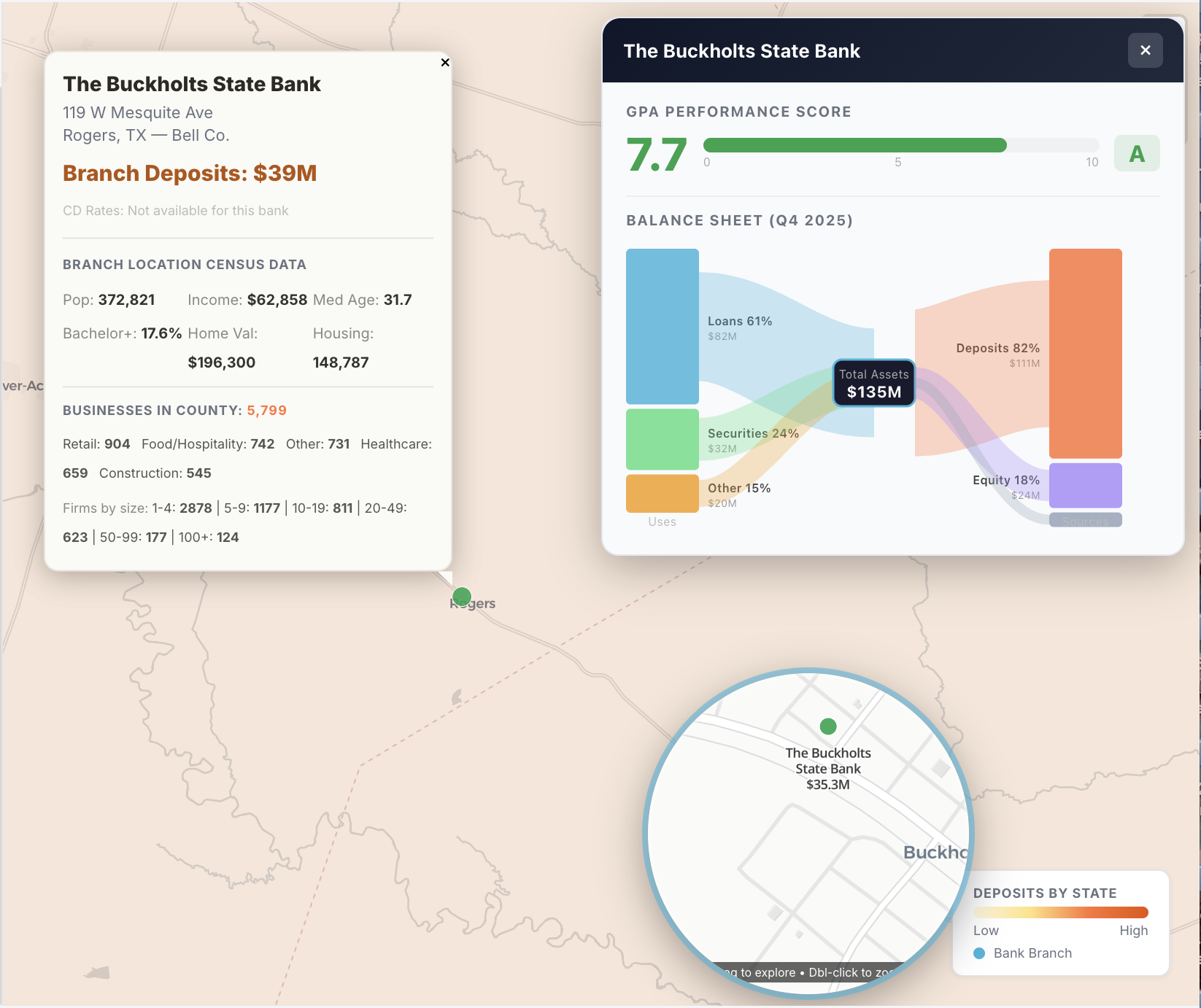
| 1 | Buckholts State Bank | 7.67 | 0.00 | 2.80% | 15.87% | 4.42% | 38.40% | $135M |
| 2 | North Valley Bank | 7.67 | 0.13 | 2.98% | 22.73% | 5.57% | 42.80% | $260M |
| 3 | First Bank of Owasso | 7.67 | 0.21 | 3.19% | 19.28% | 5.09% | 41.40% | $585M |
| 4 | American Interstate Bank | 7.67 | 0.25 | 4.00% | 22.18% | 5.34% | 27.80% | $134M |
| 5 | Bank of Monticello | 7.67 | 0.25 | 2.85% | 21.69% | 5.50% | 44.00% | $158M |
| 6 | Cumberland Security Bank, Inc. | 7.50 | 0.13 | 3.73% | 29.12% | 5.36% | 33.10% | $427M |
| 7 | FNB Picayune Bank | 7.50 | 0.13 | 3.25% | 22.56% | 5.28% | 45.70% | $282M |
| 8 | Grundy Bank | 7.50 | 0.13 | 3.08% | 21.97% | 5.03% | 45.50% | $372M |
| 9 | Durden Banking Company, Incorporated | 7.50 | 0.21 | 3.18% | 20.28% | 5.90% | 48.20% | $284M |
| 10 | Twin River Bank | 7.50 | 0.25 | 2.94% | 23.23% | 5.23% | 42.30% | $168M |
Peer average ROA: 1.08% · Peer average efficiency ratio: 63.07%
Spotlight: Why and How These Banks Succeed
#1 — Buckholts State Bank · Buckholts, TX · $135M · Community Banking · GPA 7.67
Chartered in 1907 and an SVI of 0.00: the single most predictable performance trajectory in the entire Top 10, and arguably one of the most stable in all 4,426 banks in the fleet. ROA of 2.80% against a peer average of 1.08%. Efficiency of 38.40% against a peer of 63.07%. ROE of 15.87%. In a year when a lot of community banks chased yield and slipped on discipline, Buckholts State Bank did what it has always done. No sign out front. No investor relations department. Just 117 years of knowing where it fits and executing on that relentlessly. The data here tells a remarkable story.
#2 — North Valley Bank · Thornton, CO · $260M · Community Banking · GPA 7.67
An efficiency ratio of 42.80% and ROE of 22.73% at $260M in assets makes the case that disciplined community banking is not a nostalgia play; it's a high-performance strategy that the biggest banks would recognize as real competition. ROA of 2.98% against a peer average of 1.08%. NIM of 5.57%. An SVI of 0.13 means the model sees a bank that doesn't spike and fade. It shows up quarter after quarter, runs tight, and doesn't need a dramatic story to justify its position on this list.
#3 — First Bank of Owasso · Owasso, OK · $585M · Community Banking · GPA 7.67
The largest pure community bank in the Top 10, First Bank of Owasso earns its place on merit: efficiency of 41.40%, ROE of 19.28%, ROA of 3.19%. This is Oklahoma community banking at its best: relationship-driven, operationally disciplined, and at SVI 0.21, consistent enough that the Statum model has real confidence in the forward trajectory. At $585M, this institution has scale without the typical cost bloat. That combination is much more unusual than the asset size suggests.
#4 — American Interstate Bank · Elkhorn, NE · $134M · Community Banking · GPA 7.67
The smallest bank in the Top 10 by assets. An efficiency ratio of 27.80% — the best in the entire Top 10. ROE of 22.18%. ROA of 4.00%. At $134M in Nebraska, American Interstate Bank proves that the variable determining performance is not size, it's discipline. And at $134M, they have it in quantities that banks ten times their size should be studying. SVI of 0.25 confirms the trajectory is stable.
#5 — Bank of Monticello · Monticello, GA · $158M · Community Banking · GPA 7.67
Georgia community banking with an efficiency ratio of 44.00%, ROE of 21.69%, and ROA of 2.85%. Bank of Monticello closes the 7.67 cohort the same way the best community banks close every quarter — quietly, consistently, and with fundamentals that speak louder than marketing budgets. SVI of 0.25 says the performance is durable. There is no trickery in these numbers. Just a well-run institution that knows what it does and does it well, every quarter.
#6 — Cumberland Security Bank, Inc. · Somerset, KY · $427M · Appalachian Crossroads · GPA 7.50
New to the Top 10, Cumberland Security Bank enters with compelling credentials: ROA of 3.73% against a peer of 0.95%, ROE of 29.12% against a peer of 9.49%, and an efficiency ratio of 33.10% against a peer of 64.80% — among the tightest on this entire list. At $427M in Somerset, Kentucky, this is Appalachian community banking running lean and generating returns that most regional banks would envy. SVI of 0.13 signals high forecast confidence. A strong debut.
#7 — FNB Picayune Bank · Picayune, MS · $282M · Deep South Crossroads · GPA 7.50
FNB Picayune Bank earns its place with ROA of 3.25%, ROE of 22.56%, NIM of 5.28%, and efficiency of 45.70% at $282M in assets. Deep South Crossroads peer class, SVI of 0.13. Mississippi community banking that doesn't attract national headlines but posts the kind of numbers that should. Consistent capital, tight operations, durable returns. That is the entire formula.
#8 — Grundy Bank · Morris, IL · $372M · Prairie Crossroads · GPA 7.50
Grundy Bank brings Prairie Crossroads discipline to the list with ROA of 3.08%, ROE of 21.97%, NIM of 5.03%, and efficiency of 45.50% at $372M. Morris, Illinois — not a market that generates fintech press releases — is apparently an excellent place to build a tightly run community bank. SVI of 0.13 says the model has high confidence. The numbers back it up.
#9 — Durden Banking Company, Incorporated · Twin City, GA · $284M · GPA 7.50
Twin City, Georgia. $284M in assets. ROA of 3.18%, ROE of 20.28%, NIM of 5.90%, efficiency of 48.20%, SVI of 0.21. Durden Banking Company has been a quiet performer in Georgia community banking for years. This is the data making it explicit. Solid capital, consistent returns, and a NIM of 5.90% that leads the entire Top 10. No surprises. Exactly what the SVI is designed to confirm.
#10 — Twin River Bank · Lewiston, ID · $168M · Mountain Roots · GPA 7.50
Twin River Bank closes the Top 10 with ROA of 2.94%, ROE of 23.23%, NIM of 5.23%, and efficiency of 42.30% at $168M in assets. Lewiston, Idaho — Mountain Roots peer class, SVI of 0.25. An ROE above 23% from a $168M institution in the Pacific Northwest is not accidental. It is the product of a bank that knows its market, manages its costs, and allocates capital with discipline. A worthy addition to any Honor Roll.5.19: The Number Every CEO Should Know
This is the average Statum GPA for US community banks right now. If your bank is at 5.19, it's not failing and it's not thriving. It's actually…average, in a world where that's an increasingly uncomfortable place to be.
McKinsey's 2025 Global Banking Annual Review puts its own numbers to this: AI-enabled pioneers are projected to open a four-point ROTE advantage over slow movers. That starts from a performance base. The banks that enter the next technology and competitive cycle already operating at GPA 7+ have a fundamentally different starting line than banks entering it at 5.
However, here's what the McKinsey report doesn't tell you and the Statum data does: the institutions at the top of this list didn't get there through technology. They got there through fundamentals: tight efficiency, disciplined capital, and returns that don't require a special quarter to materialize. Buckholts State Bank did not win with AI. It won with 117 years of knowing where it fits and executing on that relentlessly.
Technology amplifies what is already there. If what is already there is GPA 5.19, that is what gets amplified.
Don't Just Read This List; Find Out Where You Stand.
The Statum KPI Fleet Dashboard has every one of the 4,426 banks in the FDIC database. Just enter your bank name and in 60 seconds you'll see:
- Your score on all six GPA parameters
- Your overall Statum GPA and BankRank
- Your SVI — how stable and predictable your trajectory is
- How you compare against your true peer group across 64 specialty classes
This is not a screener built for investors. It's a mirror for bankers, showing answers to the question that every CEO is already asking: Compared to every other bank in the country right now — where do we actually stand?
150 banks already know the answer is Tier A.
The other 4,264 are about to find out where they are.
→ Access the Statum KPI Fleet Dashboard at amberoon.statumkpi.ai
Statum KPI is built by Amberoon — Big Tech for Small Banks. If your institution wants to move the GPA needle with governance-first AI, peer analytics, and performance intelligence that examiners actually understand, contact us. The 150 didn't get there by accident. Neither will you.
Popular Posts
Last week the Federal Reserve did the one thing...

In February 2026, Anthropic ran a Claude Code...